Product leadership · Customer-facing B2B & B2C products

I build customer-facing products in complicated businesses.

Jason Emerich. Director of Product Management, with nine years leading B2B and B2C product organizations on top of eight years in engineering. Mobile apps, enterprise platforms, connected hardware, two-sided marketplaces, e-commerce, and applied AI. I still get out on site with the people who use what my teams build. The work starts in a truck yard or a shop bay, not a roadmap tool.
80,000+People using a mobile product I took from idea to launch
15,000+Connected devices in the field on hardware and firmware I owned
20People in the product organization I lead today
~3MMonthly visits across the B2C e-commerce properties I owned
17 yrsBuilding software, engineering through product leadership

Selected work

Eight products, eight different problems.

Mobile, connected hardware, a two-sided marketplace, consumer e-commerce, workflow systems, and applied AI. Different shapes, same job: find out what people actually need, then get it built and shipped. All of these reached production and real users.

0 to 1 · Mobile

Driver compliance platform

Product Manager, then Manager of Digital Products

I pitched it, got the executive funding, and launched it: a mobile app for people whose office is a truck cab, covering inspections, hours, and roadside events. It grew through on-site research with drivers rather than feature requests from headquarters.

80,000+ people using it in production
Connected hardware · Regulated

Connected ELD and hours-of-service device

Director of Product Management

A proprietary Bluetooth device reading straight off the vehicle bus, shipping over-the-air firmware updates to users in the field. Hardware, firmware, and app on one roadmap, plus a multi-year Canadian certification run across product, engineering, and legal.

Deployed on 15,000+ vehicles
Workflow · Systems integration

Digital vehicle inspection reports

Director of Product Management

Replaced a paper process with a digital one wired into the core business systems, so a reported defect lands in the maintenance queue instead of riding around in a cab on a carbon copy.

Printing, postage, and manual handling gone
Real-time · Customer experience

24/7 roadside assistance

Product Manager

Treated a breakdown as a live event instead of a support ticket: repair progress as it happens, technician location on the way, and a push notification at each step so nobody is sitting there guessing.

A stranded driver can watch help coming
Marketplace · Two-sided

Third-party service provider network

Director of Product Management

Web and mobile products that brought independent repair shops into the maintenance system: submitting work, passing validation, moving through approvals and billing. Neither side shows up until the other one already has, so sequencing the rollout was most of the problem.

Independent providers wired into approvals and billing
Research · Service design

End-to-end rental experience

Director of Product Management

A national six-month initiative mapping the journey for both customers and branch employees across web, mobile, and in store. I was in the field for it. The maps turned into specific changes to the steps people were abandoning, plus new mobile capability.

Fewer people abandoning the rental halfway through
B2C · Experimentation

Consumer conversion and checkout

Director of Product Management

Three consumer properties. I treated conversion as a research question first: go find out where people stall, then design the experiment. Redesigns shipped behind A/B tests built on field research and job mapping rather than a list of guesses.

+3% conversion, -10% drop-off across ~3M monthly visits
Applied AI · Operations

AI inside the approval workflow

Director of Product Management

Directed AI-driven analysis of customer preferences for repair approvals, and shaped the customer-facing insights layer on a large ML platform. The hard part was never the model. It was making a prediction clear enough that someone would act on it.

Projected 20% less time per approval

How I work

Opinions I have earned the hard way.

01

Go where the work happens

I have never learned anything important about a product in a conference room. On-site observation, ride-alongs, and job mapping are the input. Every team I have led has picked up the habit, and every time the roadmap got shorter and better.

02

UX is how I do product

Not a partner function I check in with. I sit in the research sessions, work through the journey, and argue about what a screen has to make obvious before anyone writes a ticket. Nielsen Norman certified, though the habit matters more than the certificate.

03

Prototype before you promise

A clickable prototype settles arguments a spec cannot, and it exposes the workflow you quietly assumed away. I would rather burn a week building the wrong thing small than a quarter building it at scale.

04

Technical enough to ask better questions

Eight years in telecom, mobile device management, and desktop engineering before product. I can read a constraint, question an estimate, and tell the difference between hard and tedious.

05

Give product room to be product

I have grown an organization from four to twenty and hired more than ten PMs, but headcount is the least interesting part. A team that spends every hour on delivery and meetings stops being a product team. I protect time for discovery, competitive work, and prototyping, cut process that is not earning its keep, set clear guardrails, and let people own the problem instead of the ticket.

06

AI as leverage

I use it to shorten the distance between an idea and something I can react to: research synthesis, competitive analysis, API gap analysis, early specs, working prototypes. It means I can explore a lot more before I commit a team to any of it.

Featured · Independent project

I built a product to show how I work.

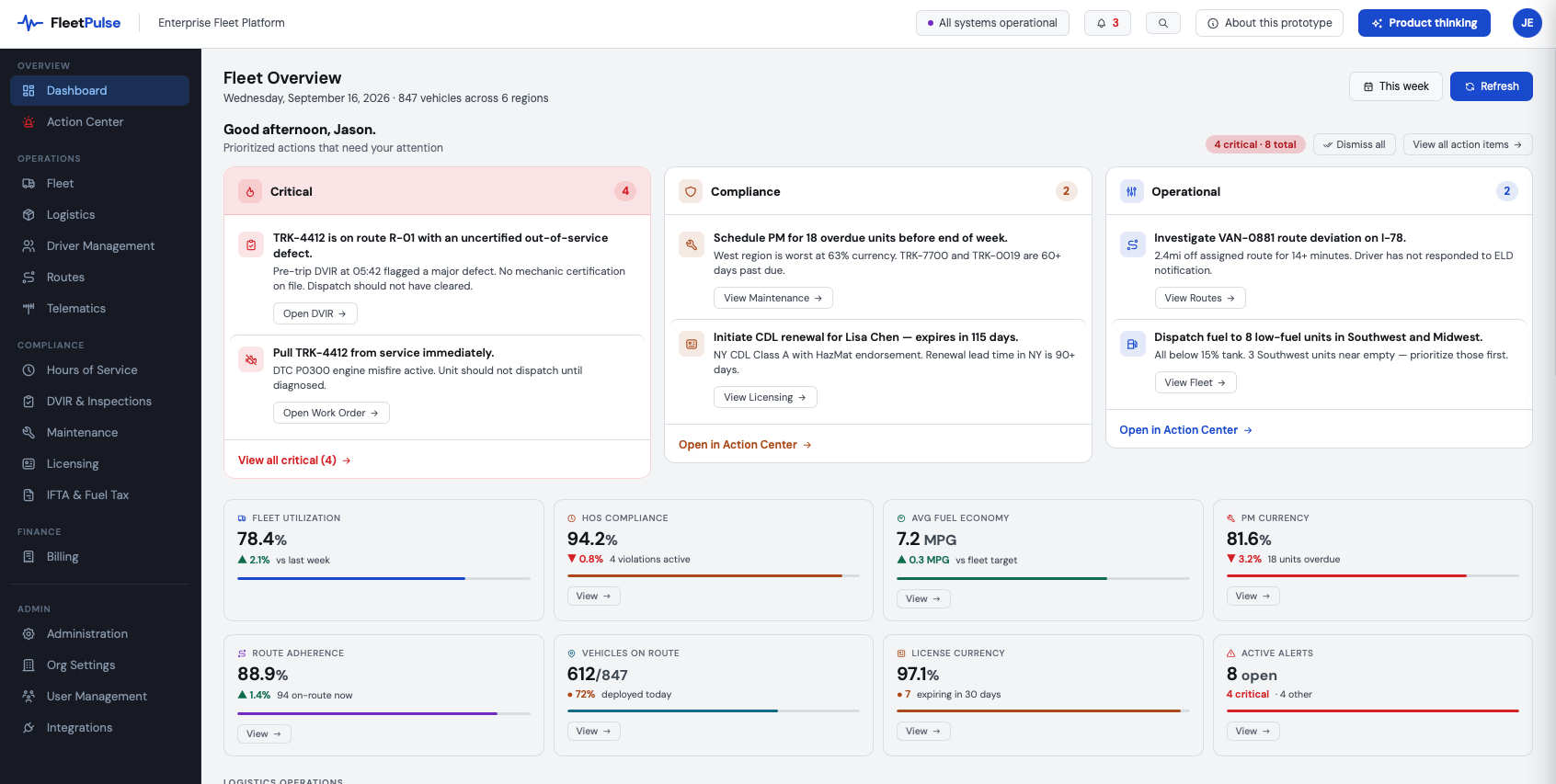
FleetPulse is an independent prototype: a fleet management platform, twelve connected modules, simulated data. It sits where four parts of my background meet. Years in the domain told me what to build. Product thinking shaped the workflows. UX decided what each screen had to make obvious. AI got me from thinking to something interactive in days instead of a quarter.

Independent project Product definition UX & information design Working prototype AI-assisted build

FleetPulse

847 vehicles, 267 drivers, 6 regions, 14 tax jurisdictions. Live telemetry, hours-of-service compliance, maintenance and work orders, driver inspections, licensing, routing, cost per mile, and quarterly fuel tax. Simulated data, no backend. Go click around.

Dashboard Action Center Fleet Driver Management Routes Telematics Hours of Service DVIR & Inspections Maintenance Licensing IFTA & Fuel Tax Billing Administration

Product decisions

  • A fleet manager's job is a queue, not a dashboard. Everything in this category ships an alert list that tells you what happened. The Action Center tells you what to do, with the action attached: pull this unit from service, ground this driver, call these two before dispatch.
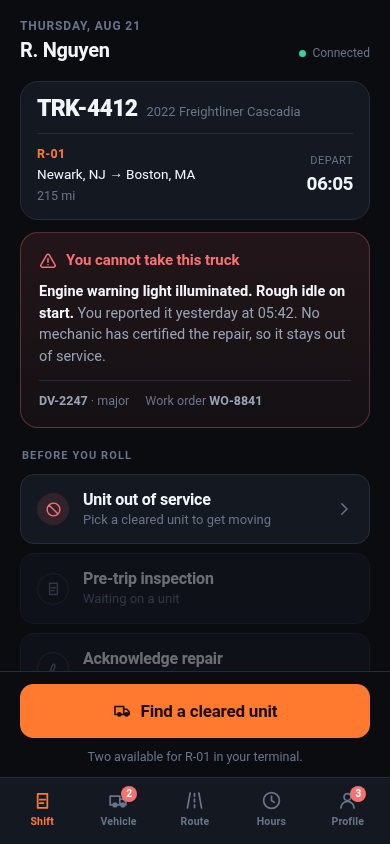
  • One record, five places. A driver inspection report shows up on the vehicle, on the driver, in the maintenance queue, and against the duty log, because those are the four places somebody needs it. An open out-of-service defect disables the Dispatch button on the vehicle record.
  • Two sources that should agree. Fuel tax is filed on mileage, and mileage comes from both telematics and the odometer. The tax module reconciles them per vehicle and flags anything over two percent before the return goes out. The inspection log and the duty log get the same treatment, since a pre-trip inspection should leave a mark in both.
  • Approval authority is separate from edit access. A maintenance manager can open a work order but cannot approve a repair over $2,500. Spending limits are a financial control, so they are modeled as their own permission rather than a step in a workflow somebody can route around.

UX decisions

  • The first thing you see is a decision. The home screen opens with the three things that need you right now and lets you clear them. Charts sit underneath. Ninety seconds before the yard opens, you still leave knowing the right things.
  • The navigation carries the workload. Live counts sit on the sidebar itself, so four hours-of-service violations and eighteen overdue services are visible before you click anything.
  • Errors say what still works. When the billing integration fails, the panel leads with what broke, what is unaffected, and how long before it costs money. That is the question the person reading it actually has.

It is a prototype with simulated data, not production software. What I wanted to show is how quickly I can get from knowing a domain to something you can click and argue with.

Fully interactive. Open a vehicle record, work the action queue, certify a driver-reported defect and watch a unit clear out-of-service, or fix the failing billing integration.

Launch the demo

Experience

Seventeen years, engineering through product leadership.

Sep 2025 → PresentFleet & mobility services

Director of Product Management, Fleet Operations Portfolio

Holman

Product leadership across a portfolio of ten-plus platforms spanning asset management, licensing and registration, purchasing, and B2B and B2C remarketing. I lead a twenty-person organization and set the multi-year strategy across it. I also brought on-site research and prototyping into a group that had not worked that way, which is why a 200-plus user platform rollout landed with far fewer post-launch problems than the last one.

Jan 2022 → Sep 2025Commercial leasing & logistics

Director of Product Management, Digital Solutions & Innovation

Penske Transportation Solutions

Owned strategy and delivery across operations, maintenance billing, service provider management, repair workflows, and driver compliance. Grew the organization from eight to eighteen PMs across eight teams, built the two-year roadmaps that carried capital approvals, and reported strategy and results to executives every month.

Dec 2018 → Jan 2022Mobile, then full platform

Manager of Digital Products

Penske Transportation Solutions

Built the mobile product function from nothing and launched two apps from zero to one, then took on the flagship B2B web portal. Hired more than ten PMs and built the onboarding program that cut ramp time in half. On-site research and journey mapping became standard practice here.

Feb 2017 → Dec 2018Individual contributor

Digital Product Manager

Penske Transportation Solutions

Full ownership of two iOS and Android products end to end. Launched the driver app now used by 80,000-plus people, and more than tripled adoption of the fleet manager app through on-site research and a short list of the right features.

Jun 2009 → Feb 2017The technical foundation

IT Engineering: Telecom, Mobile Device Management, Desktop

Penske Transportation Solutions

Eight years building and running infrastructure for a 40,000-person company. It is where the technical fluency comes from, and why I ask different questions in an architecture review.

Credentials

B.S., Management Alvernia University, Reading, PA
UX Certification Nielsen Norman Group · Credential ID 1018509
Product surfaces Native mobile, responsive web, enterprise platforms, connected hardware and IoT, two-sided marketplaces, B2C e-commerce, applied AI and ML
Regulated domain fluency DVIR, ELD, HOS, IFTA, telematics and IoT integration, OCR document capture, preventive maintenance, remarketing, service provider networks

Tools & practice

Customer discovery UX research Journey mapping Usability testing Prototyping A/B testing 0-to-1 development Product strategy Roadmapping OKRs & KPI definition Executive communication Org design & hiring Hardware & firmware PM Figma Miro Jira Confluence Google Analytics Power BI Claude ChatGPT Microsoft Copilot

Tell me what your users are complaining about.

I am always interested in how other teams are solving this. If you are working on a customer-facing product with real complexity, I would like to hear about it.